Your Property Boundaries
Boundary Search
The Boundary Search contains the legal ownership documents for each property, i.e. the Title Plan and Title Register, a Lease if one of the properties is leasehold, all available Associated Documents, a list of common law presumptions, a list of building conventions, and, optionally, a digital copy of the House & Garden Boundaries book. There is also an option to include a draft informal Boundary Agreement.
Land Registry Documents
Land Registry legislation provides that the ownership documents should describe a property boundary in a general way only, which means that the Land Registry do not set out wilfully to chronicle the property boundary details with measurements, angles or T and H marks. Rather, the boundary is shown in a general way as a red line drawn within the black line printed by Ordnance Survey.
Accordingly, a reader of Land Registry documents would expect references to boundaries to be implied rather than specifically expressed, i.e. the reader would be looking for wording that may describe a garden feature such as a path, drain or sump that uses as a means to describe its position, its distance from the boundary.
Associated Documents
Of significant benefit in identifying property boundaries are the Associated Documents, I.e. the Deeds and Deed Plans held by the Land Registry. These are mostly pre-registration documents and unlike today's ownership documents they often do contain boundary descriptions. They are frequently accompanied by a Deed Plan, which may be professionally drawn or may be hand-drawn, but such plans habitually contain T and H marks, measurements and angles. The most helpful type of Deeds are the Conveyances and Transfers, as such are those that more frequently have Deed Plans attached to them.
Unravelling the Boundaries
Disentangling a boundary dispute, in all instances, requires reference to the legal documents held at HM Land Registry, including the Title Plan. The Land Registry overlay their Title Plan on an Ordnance Survey map but this is not accurate enough in describing a boundary's width or size, nor its precise position, and so the Title Plan, by itself, is not of much practical benefit save as a general guide.
Boundary Disputes
Aerial photography, which displays an image of the property and its boundary is usually masked by vegetation, rendering the boundary position, again, untenable, and so one must turn to the Deeds and documents maintained by the Land Registry to gain further clarification. These are the documents contained in the Boundary Search and are loosely referred to as the Associated Documents.
The courts do not encourage turning to them to resolve boundary disputes because they are time consuming and expensive. Most disputes are resolved peaceably by obtaining a Boundary Search, perusing it, highlighting any salient features and then walking along the boundary and using your best efforts to decide on where the boundary is. You can then provide a copy of your documents to your neighbour and try to reach an agreement. This can then be embodied in a formal or informal boundary agreement.
Ownership Documents
In practice, an exercise to determine property boundaries will always begin with a look at the ownership documents, i.e. the Title Register and Title Plan, and any Associated Documents such as the old conveyancing deeds.
Sources of Boundary Information
There are no legally authoritative documents devoted to particularising the size, shape or angles of a property's boundaries. The only legitimate source of boundary information is that provided by the Land Registry who retain and manage the land ownership documents, primarily the Title Register and Title Plan. Their function is not to provide boundary details, but to provide ownership details. Legislation provides that the Registry need only to describe the boundaries in a general way.
Land Registry
Although a sole document is often insufficient to resolve a dispute, a composite of all the documents available from the Land Registry for each of the adjoining properties is usually sufficient. This would embrace the Title Register, Title Plan, Lease, Lease Plan, Associated Deeds and Deed Plans. These documents together with reference to any applicable Common Law Presumptions, or Building Conventions will (all of which are provided by a Boundary Search) in most cases. provide all the documentation necessary to resolve a boundary dispute.
Boundary Presumptions
All High Court judgments in England and Wales are recorded and the law resulting in the court's decisions must be followed by the lower courts. Where these judgments apply to property boundaries they fall into the frameworkl of Common Law Boundary Presumptions, developing further as more cases appear before the courts.
Common Law Boundary Presumptions
In addition to the Land Registry documents a framework of Common Law High Court decisions (judgments) have accumulated over time. These high court decisions bind the lower courts to apply the same judgments were the facts of their cases are similar, and thus provide an additional system of law to the legislative law enacted by Parliament, which can be looked at when considering boundary issues.
Decisions affecting boundaries have become known as Common Law Presumptions, and they can be reliably followed unless there is rebuttable evidence to the contrary. This is one reason why all of the legal documents must first be studied, as they are where most rebuttable presumptions would be manifest.
Building Conventions
Most fence builders will use various conventions to erect a fence and this can often be used as a starting point for determining who purchased the fence, indicative of ownership.
Building Conventions
Alongside Common Law Presumptions, and in particular regard to fence boundaries, a framework of building conventions, or best practices, have been compiled.
The compilation differs according to the type of garden fence. In practice, Building Conventions are not always followed by builders, but they can be a useful resource if there is no other evidentiary source.
Apple Books
House and Garden Boundaries
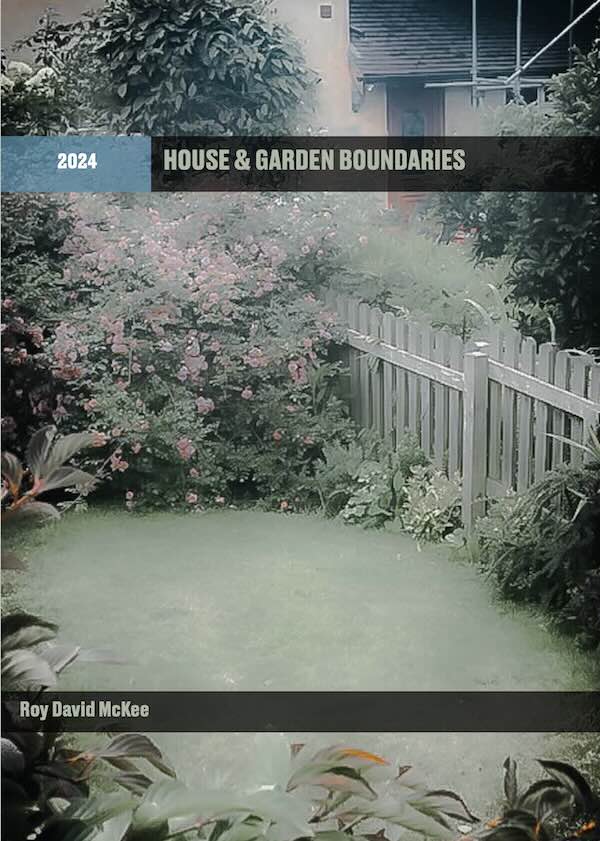
The author of the book, House and Garden Boundaries, has more than 25 years experience in the field. The Book is more than 200 pages long, and deals with all aspects of boundary identification. it is fully illustrated and descriptive of all types of boundaries, including ditches & hedges, trees, hedgerows, fences, fence-wall boundaries, non-tidal rivers, non-tidal river islands and streams. The book demonstrates how to find details of express and implied boundaries from the Title Register, Title Plan, Lease, Lease Plan, Conveyancing Deeds, and deed Plans. In addition, there are details of boundary presumptions and boundary fence protocols, all of which are fully illustrated. There is a template for an Informal Boundary Agreement, which can be adapted to each reader's needs. Finally, actual examples of case studies occupy the substantial final chapter of the book.