Articles in respect of Hedge & Ditch Boundaries
'Farming Land
Adjoining the Public Highway
Exceptions
Hedge and Ditch Presumption
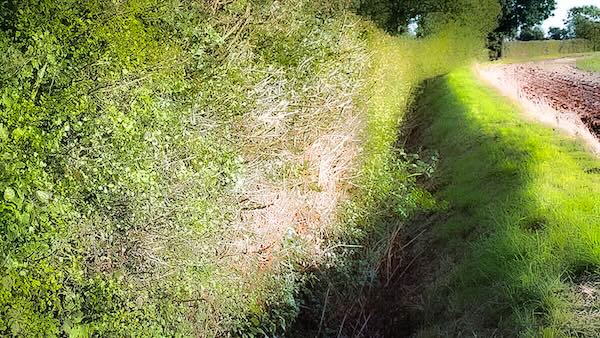
Hedge and Ditch edging from farmland
Voiles v Miller 1810
The Decided Case that first provided authority for the Hedge & Ditch Boundary Presumption, Voiles v Miller, dates to 1810 when the High Court ruled: “The rule about ditching is this. No man, making a ditch, can cut into his neighbour’s soil, but usually he cuts it to the very extremity of his own land: he is of course bound to throw the soil which he digs out, upon his own land; and often, if he likes it, he plants a hedge on top of it.”
This presumption can be rebutted by evidence to the contrary, e.g. where the ditch was dug while both sides of it were in the same ownership, but one side later sold off, or where it can be shown that the hedge was planted before the ditch was dug.
Hedge & Ditch Boundary
Where two or more properties are separated from each other by a hedge and a ditch it is assumed that the landowner dug a drainage ditch, creating a bank upon which to plant his hedge and that the ditch would therefore be on the edge of his land, so that he would be shovelling the earth onto his own land. A presumption that the boundary would be in the centre of the ditch would be incorrect; in actuality the boundary would be on the far side of the ditch as illusstrated in the image.
Alan Wibberley v Insley 1999
The House of Lords case of Alan Wibberley Building Ltd v Insley 1999 provided more modern confirmation of the rule but provided two requirements before the presumption could be relied upon, namely that the boundary must have been set before the ditch was dug and that the ditcher dug into his own land and threw the spoil into his own land, as the original case assumed.
Old Deeds can be Extrinsic Evidence
This case also confirmed that the old conveyancing deeds can still be admitted as extrinsic evidence notwithstanding registration of the property with the Land Registry. The documents replacing the Conveyancing Deeds as authoritative evidence of ownership and property description are the Title Register and Title Plan. It is often the case that the older Deeds contain far more detail than that held in the modern ownership documents.
Palmer v Upton 2015
The 2015 case of Palmer v Upton confirmed that this presumption still applies. It also elucidated that a full hedge at the time of the hearing was not necessary and that the purpose of creating the ditch did not have to be as a boundary, e.g. as with a drainage ditch.
Apple Books
House and Garden Boundaries
The author of the book, House and Garden Boundaries, has more than 25 years experience in the field. The Book is more than 200 pages long, and deals with all aspects of boundary identification. it is fully illustrated and descriptive of all types of boundaries, including ditches & hedges, trees, hedgerows, fences, fence-wall boundaries, non-tidal rivers, non-tidal river islands and streams. The book demonstrates how to find details of express and implied boundaries from the Title Register, Title Plan, Lease, Lease Plan, Conveyancing Deeds, and deed Plans. In addition, there are details of boundary presumptions and boundary fence protocols, all of which are fully illustrated. There is a template for an Informal Boundary Agreement, which can be adapted to each reader's needs. Finally, actual examples of case studies occupy the substantial final chapter of the book.